What to Do After a Hit-and-Run in Texas (Step-by-Step Guide)
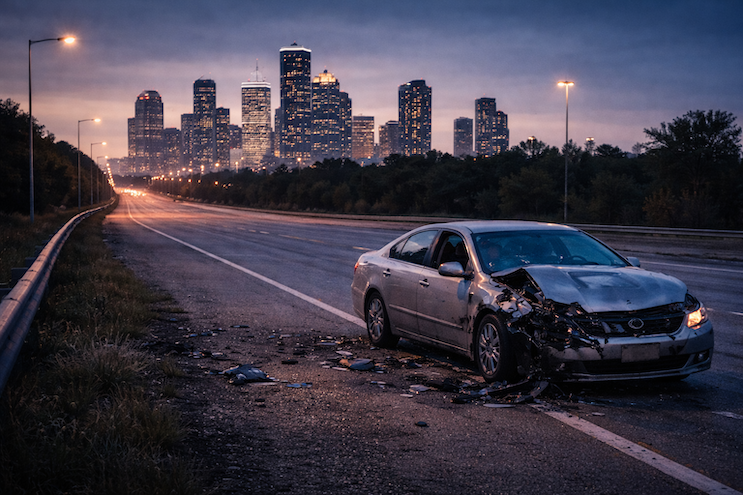
Hit-and-Run Accidents in Texas: How to Protect Your Family When the At-Fault Driver Flees
Hit-and-run crashes are uniquely stressful because the at-fault driver disappears, leaving your family to handle injuries, evidence, and insurance without the normal exchange of information.
Texas law requires drivers to stop and render aid, and leaving an injury crash can be a felony.
Financially, your best protection is strong UM/UIM coverage, but Texas requires “actual physical contact” for UM recovery when the driver is unknown.
After a hit-and-run: call 911, document everything, gather witnesses, get medical care quickly, report to your insurer, and consider legal advice if the claim turns into a fight.
If you or someone you love was hurt in a Texas hit-and-run, contact Greenberg Streich Injury Lawyers today at 832-583-3471 or request a free case evaluation.
A real-world Texas example: Houston, New Year’s Day 2026
On January 1, 2026, Houston police logged a major crash at 11801 Fondren Road near W. Bellfort around 4:30 p.m., coded “CRASH/MAJOR/FSRA.”
FSRA stands for Failure to Stop and Render Aid—the Texas legal label for a hit-and-run involving injuries (or where injuries are reasonably likely). In plain English: the at-fault driver left instead of stopping to help.
When that happens, families are left with immediate, practical questions:
- What do we do right now?
- How do we prove what happened?
- Who pays the medical bills and car repairs if the driver is never found?
This step-by-step guide answers those questions in a way that’s Texas-specific, easy to understand, and focused on protecting your family.
Why hit-and-run crashes are a growing crisis
Hit-and-run crashes aren’t rare outliers anymore. Nationally, the problem has been trending in the wrong direction for years. For example, an NHTSA Crash Stats report lists 2,872 hit-and-run fatalities in 2023, and other analyses note a dramatic increase over the longer term.
Texas has its own amplifiers:
- Big metros with dense traffic
- Long commutes
- A high rate of uninsured/underinsured drivers (more on that below)
- And a subset of drivers who flee because stopping would expose something worse
Why do drivers flee a crash?
In case after case, people run because they believe the consequences of staying are worse than the consequences of leaving:
- They’re intoxicated
- They don’t have a valid license
- They have no insurance (or not enough)
- They have warrants or other legal exposure
None of that helps your family. It only makes your recovery harder—medically, financially, and emotionally.
Texas law: the duty to stop and render aid (FSRA)
Texas doesn’t treat “leaving” as a minor mistake when injuries are involved.
Under Texas Transportation Code § 550.021, a driver involved in a collision that results (or is reasonably likely to result) in injury or death must stop and remain at the scene.
And under § 550.023, the driver must provide information and render reasonable assistance, which can include calling 911 and arranging transport for medical care when needed.
The point of these laws is simple: when someone is hurt, you don’t get to disappear.
Criminal consequences: fleeing can be a felony in Texas
Leaving an accident scene when someone is hurt carries severe penalties. Texas has escalated the punishments to deter drivers from fleeing. Depending on the outcome of the crash, the consequences include:
- If someone is seriously injured: It is a third-degree felony, punishable by 2 to 10 years in prison and up to a $10,000 fine.
- If someone is killed: It is a second-degree felony, with penalties of 2 to 20 years in prison and up to a $10,000 fine.
- If injuries are less severe (“minor” injuries): Fleeing is still a felony. Conviction can mean up to 5 years in prison (or up to 1 year in county jail) and a $5,000 fine.
The real nightmare for those hit: insurance and money after a hit-and-run
Here’s the part families usually learn too late: Even if the police do everything right, many hit-and-run drivers are never identified, and even when they are, they may not have insurance or assets that can actually pay your damages.
Texas has a major uninsured driver problem
Depending on the source and methodology, estimates vary, but Texas is consistently discussed as a state with a high uninsured driver share. For example:
- The Texas DMV has been cited in legislative materials estimating around 20% of Texas drivers are uninsured.
- The Insurance Information Institute has reported a 2023 uninsured motorist rate of 14.5% for Texas (still very high).
Why this matters: the driver who flees is often the driver who can’t (or won’t) pay. So if you’re relying only on “their insurance,” a hit-and-run can leave your family exposed.
UM/UIM coverage: the safety net many Texans accidentally waive
Uninsured/Underinsured Motorist (UM/UIM) coverage is designed for exactly this moment:
- The at-fault driver has no insurance
- The at-fault driver has not enough insurance
- The at-fault driver is unidentified (classic hit-and-run)
Important Texas detail: the “actual physical contact” rule
Texas UM coverage has a trapdoor that surprises people: If the at-fault driver is unknown, the uninsured motorist statute requires actual physical contact between the unknown vehicle and your person or property for UM recovery.
What that means in real life:
- If a hit-and-run vehicle hits you and drives off, UM is often in play.
- If a “phantom driver” causes you to swerve and crash without contact, UM may be denied under that rule, so you may need to lean on collision, PIP/MedPay, or other coverage instead.
Why UM/UIM matters even when the driver is found
Texas minimum liability limits of $30,000/person and $60,000/accident are often nowhere near enough for a serious injury crash. Even if the fleeing driver is identified later, underinsured motorist coverage may be what fills the gap when medical bills and lost income exceed their policy.
What to do after a hit-and-run in Texas (step-by-step)
When people read legal articles, they usually want one thing: a plan they can follow when they’re panicking.
Here it is.
1) Get safe, then call 911
- Move out of danger if you can do so safely.
- Call 911 and request police + medical help.
- Do not chase the driver. Chasing increases risk and can wreck the timeline of evidence.
2) Capture identifying details—fast
If you can safely do it, write down or record:
- License plate (even partial)
- Make/model/color
- Damage patterns (missing bumper, broken tail light)
- Direction of travel
Small details matter later more than you’d think.
3) Find witnesses and lock in contact info
Ask witnesses for:
- Name
- Phone/email
- A quick voice memo statement (if they’ll do it)
Witnesses disappear fast—especially in busy Texas traffic corridors.
4) Document the scene like you’re building a case (because you are)
Take photos/video of:
- Your vehicle damage
- Skid marks, debris, and road conditions
- Surrounding businesses (possible cameras)
- Your visible injuries (when appropriate)
5) Make sure an official report exists
Insurance companies lean heavily on police documentation in hit-and-run claims.
6) Get medical care the same day (or ASAP)
Adrenaline lies. Concussions, soft-tissue injuries, and internal issues can show up later. Prompt care protects your health and creates a medical record connecting your symptoms to the collision.
7) Notify your insurance company—but choose your words carefully
When reporting, stick to facts:
- “We were hit by a vehicle that fled.”
- “Police responded; report number is ____.”
- “We’re seeking medical evaluation.”
Avoid guessing about speed, fault percentages, or making statements like “I’m fine” when you aren’t sure yet.
8) Review your coverages: UM/UIM, collision, PIP/MedPay
Ask your adjuster (in writing if possible):
- Do I have UM/UIM? What are my limits?
- Do I have UM property damage?
- Do I have collision and what’s the deductible?
- Do I have PIP or MedPay?
If your family is juggling treatment, missed work, and a totaled vehicle, identifying your available coverage early can reduce financial pressure.
9) Talk to a lawyer if injuries are serious or the claim gets adversarial
A hard truth: in UM claims, your insurer can start acting like the other side—questioning treatment, minimizing injury impact, disputing wage loss, or fighting valuation.
If the injuries are significant, if the insurer disputes contact/fault, or if your family’s future is materially affected, legal advice can help level the field.
Deadlines that can quietly hurt your case
Two timelines matter in almost every Texas injury crash:
The civil statute of limitations (generally two years)
Texas generally gives injury victims two years to file suit for personal injury and wrongful death claims.
Insurance policy notice deadlines (often much shorter)
Policies frequently require prompt notice and cooperation. These aren’t always intuitive, and missing them can create avoidable disputes. The safest approach is to report quickly and keep a paper trail.
A “protect your family” insurance checklist (use this today)
Pull up your declarations page and look for:
- UM/UIM Bodily Injury: ideally matched to your liability limits
- UM Property Damage: especially if you want the lower-deductible option in many cases
- Collision coverage: your backup if UM doesn’t apply (including no-contact “phantom driver” scenarios)
- PIP or MedPay: helpful for immediate medical bills and wage interruption
- Rental reimbursement + towing: small add-ons that feel huge after a crash
If you don’t understand what you’re seeing, ask your agent to explain it in plain English. Five minutes now can prevent a five-figure problem later.
FAQs
Will uninsured motorist coverage pay for a hit-and-run in Texas?
Often yes, but Texas law requires actual physical contact when the at-fault driver is unknown, and insurers will scrutinize proof.
What if a phantom driver makes me swerve but doesn’t hit me?
In a no-contact scenario, UM may be denied under the actual physical contact requirement. You may need to use collision coverage, PIP/MedPay, or other benefits instead.
How long do I have to file a lawsuit after a Texas hit-and-run?
Generally, two years for personal injury and wrongful death claims, with limited exceptions.
What evidence helps most in a hit-and-run claim?
Police report, photos/video, witness info, dashcam footage, nearby surveillance leads, prompt medical records, and proof of “contact” when UM is involved.
If the driver is found later, can I still recover?
Possibly. You may have a claim against the driver and/or their insurer, and your UM/UIM coverage may still matter if their coverage is insufficient.
Hit-and-run crashes create two immediate problems: you are injured, and the person responsible is gone.
That combination can turn basic questions, like who pays for treatment and how you replace a totaled vehicle, into a months-long fight with insurance. You do not have to navigate that alone.
Greenberg Streich Injury Lawyers handles serious injury cases across Texas, including hit-and-run crashes and uninsured or underinsured motorist (UM/UIM) claims. We will review the facts, help you understand your coverage options, and map out the cleanest path to compensation based on what the evidence and the policy actually allow.
If you want a straightforward assessment of your next steps, call 832-583-3471 to contact Greenberg Streich Injury Lawyers or request a free case evaluation.